
When your child has an Individualized Education Program, every line on that document carries weight, the goals, the services, the accommodations. As a parent navigating North Carolina's school system, you may have wondered whether the ABA therapy your child receives outside of school can do more than it's already doing. The answer is yes, and the connection between private ABA and your child's IEP is stronger than most families realize.
Applied Behavior Analysis is built on data, precise, measurable, objective data about how a child learns and responds to their environment. That same rigor is exactly what IEP teams need when setting annual goals, reviewing progress, and deciding what supports belong in the classroom. Understanding how these two systems work together can make you a more effective advocate for your child.
An Individualized Education Program is a legally binding document developed under the Individuals with Disabilities Education Act (IDEA), specifically Part B, which covers children ages 3 through 21. In North Carolina, the process is overseen by the NC DPI Exceptional Children Division, which sets the state's policies for special education services, eligibility categories, and procedural safeguards.
Source URL: https://www.dpi.nc.gov/students-families/exceptional-children
Every IEP must include measurable annual goals tied to the child's present levels of academic achievement and functional performance. For children with autism, those goals frequently touch on communication, social skills, behavior regulation, and daily living tasks, all areas that fall squarely within ABA's scope.
Here is where private ABA enters the picture. Your child's BCBA collects data on skill acquisition and behavior every session. Over weeks and months, that data builds a detailed picture of where your child is succeeding and where they are still developing. Bringing that information to an IEP meeting, in the form of progress graphs, quarterly reports, or a written summary, gives the team concrete evidence to work with, rather than anecdotal observations. It is entirely appropriate, and often powerfully effective, to request that BCBA data be considered when the team writes or revises IEP goals.
One reason ABA and IEP planning work so well together is that the skills ABA practitioners target mirror what schools ask of students every day. A child's ability to function in a classroom depends on a cluster of foundational behaviors that ABA addresses systematically.
Before a child can access the academic curriculum, they need to sustain attention and follow multi-step instructions. ABA programs often include discrete trial training or naturalistic teaching to build these foundational skills. Progress in this area translates directly into a school-based IEP goal such as "The student will follow a two-step verbal instruction in the classroom with 80% accuracy across three consecutive observation periods."
Functional communication is a core ABA target. Teaching a child to request help, indicate they are confused, or signal that they need a break reduces problem behavior and builds school readiness. If your child's ABA program is working on manding (requesting) through a communication device, spoken language, or sign, that work feeds directly into IEP goals around augmentative and alternative communication.
Moving from one activity to another, from reading to math, from the classroom to the cafeteria, is one of the most consistent triggers for behavioral difficulties in school. ABA programs address transitions through structured preparation, visual supports, and gradual exposure. BCBA data on transition success rates can help an IEP team decide whether transition support should be written into the child's program as an accommodation or a direct service.
For many children with autism, peer relationships do not develop naturally without targeted support. ABA social skills programming, often delivered in group formats, builds specific behaviors like initiating conversations, taking turns, and reading social cues. These skills map to IEP goals in the social-emotional domain and to participation benchmarks in inclusive settings.
When a student's behavior affects their ability to learn, IDEA requires the IEP team to consider a Functional Behavior Assessment and develop a Behavior Intervention Plan. In North Carolina, BIPs must be grounded in assessment data, not assumptions. A BCBA who has conducted a thorough functional behavior assessment is uniquely positioned to provide that data. Sharing your child's FBA report and current BIP data from private ABA can help the school's team write a BIP that is actually linked to function, not just a list of consequences.
A question parents often ask is: if my child receives ABA at school, why do they also need private ABA? The two are not interchangeable, and the distinction matters.
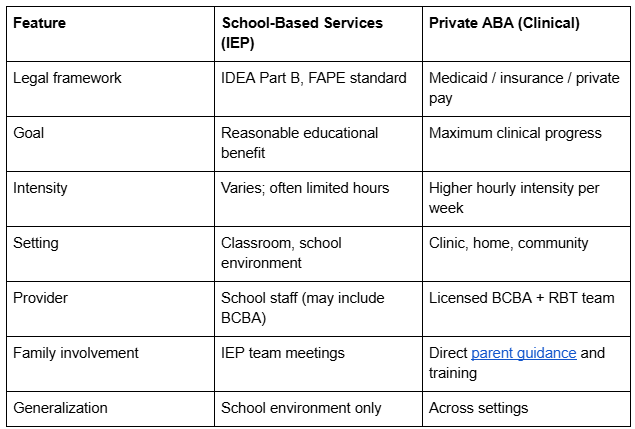
The legal standard for school services is "free appropriate public education", FAPE. Appropriate does not mean optimal. Schools are required to provide services sufficient to allow a child to make meaningful educational progress, but they are not required to provide the best possible intervention. Private ABA, at higher intensity and with a broader scope, often closes the gap between what schools can provide and what a child needs to thrive.
Coordination between a private BCBA and a school team is not automatic, it requires intentional effort and, often, a parent who advocates for it. Here is what that process typically looks like.
First, a parent can sign a release of information allowing the private ABA provider and the school to communicate. Once that is in place, the BCBA can share assessment reports and progress data with the school psychologist, special education teacher, or school-based BCBA if one is on staff.
Second, a parent can request that the private BCBA attend an IEP meeting as a participant or submit a written report for the team to consider. Schools cannot require this, but they also cannot prevent it. Bringing your child's ABA therapy team into the IEP conversation creates alignment rather than duplication.
Third, IEP goals written collaboratively, with input from the BCBA, are more likely to be measurable, achievable, and consistent with the strategies already working in the private setting.
If you believe your child needs ABA-aligned supports in their IEP and the school is not providing them, you have procedural rights under IDEA. You can request an independent educational evaluation at public expense if you disagree with the school's assessment. You can bring an advocate or attorney to any IEP meeting. You can file a state complaint with the NC DPI Exceptional Children Division or request mediation or a due process hearing.
The NC State Board of Education's policies on exceptional children and IDEA Part B provide the framework. Knowing those rights puts you in a stronger position at every IEP table.
Source URL: https://www.dpi.nc.gov/students-families/exceptional-children/policies-and-procedures
For families using NC Medicaid, it is worth noting that ABA therapy is a covered benefit under Clinical Coverage Policy 8F. This means the private ABA your child receives may be funded through Medicaid, making high-intensity services more accessible alongside what the school provides.
When choosing a private ABA provider in North Carolina, verify that the supervising clinician holds a license through the NC Behavior Analyst Licensure Board. Licensure in NC is required to practice independently and to bill insurance or Medicaid, it is your primary indicator of qualified, accountable care.
Yes. Parents have the right to invite individuals who have knowledge or expertise relevant to their child to participate in IEP meetings. Your child's BCBA qualifies under this provision. You can request this in writing to the school prior to the meeting.
The IEP team must consider all relevant information, including evaluations and reports submitted by parents. While the school team makes the final decisions, they cannot simply ignore data you bring to the table. If you feel your input is being disregarded, document it in writing and request a prior written notice explaining the team's reasoning.
A Behavior Intervention Plan in school is developed based on an FBA and is tied to the educational environment. Private ABA is a comprehensive clinical program targeting a broader range of skills across settings. The two should be aligned wherever possible, consistent strategies reduce confusion and accelerate progress.
Yes. ABA therapy for children with autism is covered under NC Medicaid Clinical Coverage Policy 8F. This is separate from what the school provides and can run concurrently with IEP services.
The NC Behavior Analyst Licensure Board maintains a public directory of licensed behavior analysts in the state. You can verify any provider's license status through that directory before beginning services.
Navigating school meetings, legal frameworks, and clinical recommendations at the same time is a lot to hold. The Sunny Skies ABA team works with families across North Carolina to make that process less overwhelming, from conducting assessments that support IEP planning to providing BCBA reports that give school teams something concrete to work with.
Our BCBAs understand the NC DPI Exceptional Children framework, IDEA Part B requirements, and what it takes to write IEP goals that are measurable and meaningful. We also offer parent guidance so you feel prepared, not just present, at your child's IEP meetings.
If you are ready to talk about how private ABA can strengthen what your child's school is already doing, we would be glad to connect. Book a consultation with Sunny Skies ABA and let's build a plan that works across every setting where your child learns.
Parents of children with autism in North Carolina often face moments of intense behavior that can feel overwhelming. When a child screams, cries, or falls to the floor in a grocery store, it can be difficult to know whether the behavior is a tantrum or a meltdown. While these two responses may look similar on the surface, they are fundamentally different in cause, function, and how a parent should respond. For families seeking autism therapy in North Carolina, understanding this distinction is one of the most practical tools for supporting a child's daily life.
Read More
Many parents in North Carolina notice their child struggling with focus, social interactions, or emotional regulation and wonder whether autism or ADHD might be the cause. Both conditions can look similar on the surface, especially in early childhood, which is why understanding the differences matters. Getting the right diagnosis early can shape the type of support your child receives, from behavioral therapy to classroom accommodations. For families exploring autism therapy in North Carolina, knowing where autism ends and ADHD begins is a critical first step toward the right care plan.
Read More
Choosing the right autism therapy for your child in North Carolina is a meaningful step toward supporting their growth and independence. By understanding the options available and working with qualified professionals, your family can build a therapy plan that meets your child where they are and helps them reach their full potential. Reach out to Sunny Skies ABA to explore personalized therapy options in Raleigh and across North Carolina.
Read More