
The sessions are not happening in a therapy room. They are happening at your kitchen table at seven in the morning while your child tries to eat breakfast and your dog keeps walking through the frame. That is not a problem. That is the point.
In home autism therapy North Carolina families use is built around the idea that a skill learned in a clinic still has to transfer to the places where your child actually lives. The research is consistent: generalization of skills, particularly daily living and communication skills, tends to be stronger when therapy happens in the natural environment from the start. Here is what that looks like in practice, who it works best for, and what families need to make it sustainable.
In-home ABA is not the same as sending a therapist to babysit. A Registered Behavior Technician arrives at a scheduled time and works directly with your child using a written treatment plan authored by a Board Certified Behavior Analyst. The BCBA designs every goal, supervises the technician, reviews session data, and adjusts the plan when something is not working.
What the RBT does during a session depends entirely on your child's current goals. One morning that might mean practicing a toileting routine in the actual bathroom. Another afternoon it might mean working on requesting a preferred toy in the living room, with a sibling nearby so the skill has a real audience. Goals are broken into small steps, every session is documented, and the plan changes as your child progresses.
You can see an overview of how our programs are structured on the Sunny Skies ABA services page.
Every ABA provider will tell you that generalization matters. Fewer explain what it costs when it is not built in from the start.
A child who learns to wash hands at a therapy sink has learned to wash hands at a therapy sink. The height is different at home. The soap smells different. Nobody is offering a preferred reinforcer afterward. That gap is not hypothetical, it comes up constantly in clinical practice.
When therapy starts where the skill actually needs to happen, generalization is not a phase you add at the end. It is built into every session. Research comparing clinic-based and home-based ABA has found that children can move through structured academic and language targets faster in a clinic setting, while home-based sessions tend to produce stronger gains on daily living skills and behavior management in the child's own environment.
Neither format is universally superior. Many families use a combination. Our comparison of in-home versus clinic-based ABA therapy walks through the tradeoffs in detail.
The families who get the most out of home-based therapy tend to have a few things in common. None of it requires a perfect household, but the honest version of this is worth saying.
Research consistently links better ABA outcomes to higher therapy intensity, earlier start age, and consistent BCBA supervision. Frequent last-minute cancellations undercut all three. If your child's schedule is unpredictable because of your own work hours or other caregiving demands, that is worth raising directly with your intake coordinator before services start. There are often scheduling options, including early morning or late afternoon slots, that fit real family lives better than a standard 9-to-5 block.
Most providers require an adult caregiver to be present in the home during in-home sessions. That is not just a liability policy. It is because caregiver involvement is one of the strongest predictors of how well skills transfer into everyday life. You do not need to sit through every minute of every session, but you should expect to be coached on the strategies your child's team is using.
Systematic reviews and meta-analyses of parent training in ABA report small to moderate positive effects on both child outcomes and caregiver wellbeing. The coaching component is worth protecting even when the schedule is tight. Our parent guidance services are structured to fit alongside therapy rather than on top of it.
Families sometimes worry their home is not set up for therapy. It does not need to be. A reasonably quiet area where your child can focus, with access to the rooms where goals actually happen, is sufficient. Most sessions run in living rooms and at kitchen tables. You do not need a dedicated therapy room or special equipment.
North Carolina is geographically large, and for families outside the Triangle, Charlotte, or Triad metro areas, the nearest autism center can be an hour or more away each direction. A three-hour round trip several times a week is not sustainable for most families, and therapy often quietly gets cut short or stopped entirely because of it. In-home services remove that barrier. Consistent weekly hours stay within reach regardless of where you live.
ABA center schedules often follow business hours that do not align with school holidays. Home-based providers typically have more flexibility around early dismissal days, teacher workdays, and summer schedules. For children who struggle with routine disruption, keeping therapy consistent through summer can make September significantly easier. Our post on supporting children through summer with ABA therapy covers specific strategies for the school break season.
Turning-taking, sharing, tolerating losing a game, and asking to join someone's activity are skills that are genuinely hard to practice with an adult. A sibling who has been coached on how to invite your child into a structured activity becomes a daily practice partner in a way no therapist can replicate. RBTs working in the home can coach brief sibling interactions as a natural part of session work.
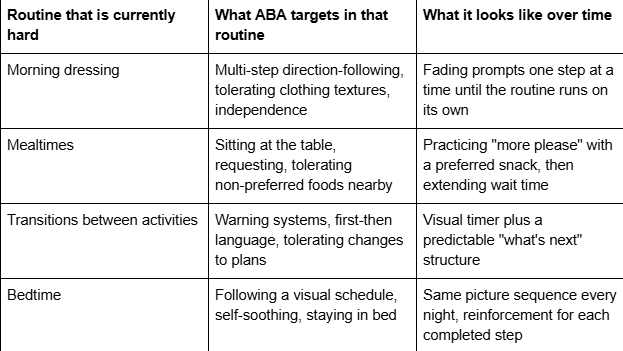
The most powerful thing about home-based ABA is that hard parts of the day become the curriculum.
North Carolina Medicaid covers ABA under Clinical Coverage Policy 8F, Research-Based Behavioral Health Treatment for Autism Spectrum Disorder. Services require prior approval, and the treatment plan must be written by a Licensed Qualified Autism Service Provider and reviewed at least once every six months. The service location, including the home, must be documented in the approved plan.
North Carolina Senate Bill 676, effective July 1, 2016, requires large group health plans to cover autism treatment including ABA for individuals through age 18, with an annual benefit cap of $40,000 adjusted annually for the Consumer Price Index. Self-funded employer plans follow federal law and may differ. Most commercial plans that cover ABA in a clinic setting also cover home-based sessions, but verify your own policy before starting.
Military families in North Carolina access ABA through the TRICARE Autism Care Demonstration. TRICARE covers in-home sessions under the same authorization process as clinic-based care. The Individual Treatment Plan submitted by your BCBA specifies the service setting. Humana Military administers TRICARE East, which covers most of North Carolina.
The state also licenses behavior analysts through the North Carolina Behavior Analyst Licensure Board. Ask any provider who will supervise your child's program to confirm both their national certification and their NC licensure.
In-home therapy is not the right setting for every child at every point in their development. It tends to be the strongest fit when:
The goals are centered on daily living skills, behavior in the home, or communication in natural settings. The child has difficulty with transitions, long car rides, or new environments. The family lives in a rural area where clinic access requires significant travel. The child is very young and the parent-coaching component is central to the plan.
It may not be the best primary setting if the child needs intensive peer interaction, highly structured learning trials that require a controlled environment, or specialized equipment a clinic provides. Many families start in one setting and shift over time. Our guide to ABA therapy options for working parents in North Carolina covers how scheduling works across different formats.
Both settings produce results, and the stronger choice depends on your child's specific goals. Research suggests clinic settings have advantages for structured skill acquisition and academic targets, while home settings show advantages for generalizing daily living skills and managing behavior in the child's own environment. Many families use a blend as their child's needs evolve.
You need to be in the home and available, but you do not need to observe every minute. Most teams will ask you to join for portions of the session for coaching. The more you can apply strategies between sessions, the faster your child's skills tend to generalize.
ABA funded by insurance generally requires a formal autism diagnosis from a qualified provider before services begin. If your child is under three, North Carolina's 16 Children's Developmental Services Agencies deliver early intervention through the NC Infant-Toddler Program, which can begin before a diagnosis is finalized.
Hours are determined by your child's assessment and the treatment plan, not by a formula. Younger children and those with more intensive needs typically start with more hours. Your BCBA will explain the recommendation and what it is based on. Higher therapy intensity has been associated with stronger outcomes in the research, but the right number is individual.
This is more common than families expect, and experienced providers have structured ways to address it. Initial sessions often focus on building rapport through preferred activities before structured work begins. If a child is genuinely distressed by the home setup, a brief period in a neutral setting can help bridge to home-based sessions.
If you are weighing whether home-based sessions make sense for your child right now, a short conversation with our team can help. We serve families across North Carolina, including areas well outside the major metro centers, and we are familiar with the scheduling, insurance, and practical questions that come up most.
There is no commitment and no pressure. Book a consultation with Sunny Skies ABA and tell us about your child and your family's situation. We will give you an honest answer about whether home-based therapy is the right next step.

Choosing the right autism therapy for your child in North Carolina is a meaningful step toward supporting their growth and independence. By understanding the options available and working with qualified professionals, your family can build a therapy plan that meets your child where they are and helps them reach their full potential. Reach out to Sunny Skies ABA to explore personalized therapy options in Raleigh and across North Carolina.
Read More
Every parent wants their child to grow up with the confidence and ability to handle everyday tasks independently. For families of children with autism spectrum disorder (ASD) in North Carolina, applied behavior analysis offers a structured, evidence-based path toward building those essential daily living skills. From brushing teeth and getting dressed to following routines and communicating needs, ABA therapy breaks complex tasks into manageable steps that children can learn at their own pace.
Read More
By the time most families start asking about intensive support, they are already tired. Maybe your child gets hurt, or someone else does, when things get overwhelming, and school has started calling before lunch. Maybe you have tried a few hours a week and it has not been enough. None of that means you did something wrong, or that your child is a problem to be fixed.
Read More