
The evaluation is finished, the paperwork is signed, and suddenly three new sets of initials are floating through every conversation: BCBA, BCaBA, RBT. Someone tells you the BCBA will write the plan. Someone else says the RBT will run the sessions. You nod politely while quietly wondering who is actually in charge of your child.
It is a fair question. The ABA therapy specialists North Carolina families work with each hold a different level of training and carry a different piece of the job. Once you know who does what, asking good questions gets much easier. Here is what a BCBA is, what the role looks like on an ordinary Tuesday, and what state licensure adds.
BCBA stands for Board Certified Behavior Analyst. The credential comes from the Behavior Analyst Certification Board, an independent body that sets the standards, writes the exam, and enforces an ethics code for the field.
Earning it is not quick. A BCBA credential requires at least a master's degree plus coursework approved by the certification board, supervised fieldwork with real clients, and a passing score on the certification exam. Certificants then keep up continuing education to renew.
So when a BCBA signs off on your child's program, a national body has already verified that this person studied the science, practiced under a mentor, and passed a standardized exam. The full checklist lives on the Behavior Analyst Certification Board's BCBA page.
Most parents picture the BCBA on the floor with their child. Usually they are not, at least not every session. Think of the BCBA as the clinician who builds and steers the program.
Everything starts with assessment. The BCBA observes your child, interviews you, reviews records, and often runs a functional behavior assessment to understand why a challenging behavior keeps happening. From there comes a written treatment plan listing goals, teaching strategies, and how progress will be measured. Your insurer or Medicaid reviewer reads that same plan, so it has to be specific.
Good goal selection is a conversation, not a handout. A BCBA should ask what your mornings look like, what makes bedtime hard, and what you most want your child to be able to do six months from now. Goals are written to be observable and measurable so nobody is guessing. If a goal does not feel meaningful to your daily life, say so.
The Registered Behavior Technician runs most of the direct sessions. The BCBA trains that technician on your child's specific programs, watches sessions, models the tricky parts, and gives feedback when a plan changes. Our team explains this shared structure on our about us page.
Session data is the BCBA's steering wheel. They graph what the technician recorded, look for trends, and decide whether to hold, tweak, or retire a goal. A program that is not moving should be changed, not repeated louder. See our post on how ABA therapists use data to measure progress.
BCBAs also teach caregivers. Systematic reviews of parent training for autism report small to moderate positive effects on child and parent outcomes, which is why most plans build in caregiver sessions. The BCBA may also coordinate with your child's school team, speech therapist, and pediatrician so everyone teaches the same skill the same way.
These three roles get used interchangeably in casual conversation. Here is the clean version.
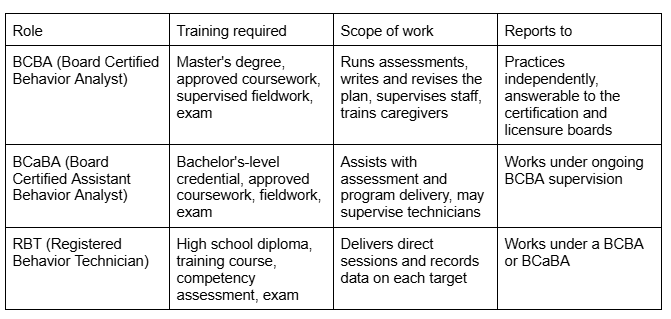
You may also see BCBA-D, which simply means a BCBA with a doctoral degree.
National certification is only half the picture here. North Carolina licenses behavior analysts through the North Carolina Behavior Analyst Licensure Board, joining 35 other states that require licensure as of 2025. Licensure means the state, not just a national board, can review complaints and set conditions on practice.
Then there is the acronym that trips up nearly every NC parent reading Medicaid paperwork: LQASP, or Licensed Qualified Autism Service Provider. Under NC Medicaid Clinical Coverage Policy 8F, services require prior approval, and the treatment plan must be written by an LQASP and reviewed at least once every six months.
Policy 8F also changes over time. NC DHHS posted a draft revision on May 15, 2026, with a comment period through June 14, 2026, so confirm current requirements with your provider. Coverage details vary by plan, so verify your own benefits directly.
Studies have linked better ABA outcomes to higher therapy intensity, earlier start age, and consistent BCBA supervision. Supervision is not a billing formality. It keeps your child's program accurate week to week.
In practice, strong supervision means the BCBA observes live sessions on a regular schedule, not only when something goes wrong. The plan gets revisited when data flattens out, and you hear from the BCBA directly rather than only through the technician. Our guide to how behavior intervention plans are created in ABA therapy covers what belongs in that document.
Bring this list. A good clinician will welcome all of them.
Still comparing providers? Our post on how to choose an ABA therapy provider in North Carolina covers the wider vetting process.
BCBA stands for Board Certified Behavior Analyst, a graduate-level credential issued by the Behavior Analyst Certification Board. Earning it requires at least a master's degree, board-approved coursework, supervised fieldwork with clients, and a passing exam score. Certificants also follow an ethics code and complete continuing education to keep the credential active.
A BCBA designs and oversees the program, while an RBT delivers the sessions. The BCBA completes assessments, writes the treatment plan, selects goals, and supervises staff. The Registered Behavior Technician works directly with your child, teaches the targets in the plan, and records data on each one. RBTs always work under BCBA or BCaBA supervision.
Not quite. The BCBA credential is national, while licensure in North Carolina comes separately from the state licensure board. Most practicing behavior analysts in the state hold both. Certification shows the person met national training standards, and licensure gives the state authority to regulate practice and respond to complaints.
LQASP stands for Licensed Qualified Autism Service Provider, the term NC Medicaid uses in Clinical Coverage Policy 8F. Under that policy, services require prior approval, and the treatment plan must be written by an LQASP and reviewed at least once every six months. On a form, LQASP means the licensed clinician responsible for your child's plan.
There is no single right number, because supervision frequency depends on your child's needs, the hours authorized, and the funder's requirements. What matters is consistency. Ask how often the BCBA observes sessions in person, how often the plan is reviewed, and how you will hear about changes. Vague answers are worth noticing.
No. Diagnosing autism sits outside the scope of a behavior analyst. Diagnoses generally come from a developmental pediatrician, child psychologist, psychiatrist, or another qualified licensed clinician. A BCBA uses that existing diagnosis, plus their own behavioral assessments, to build a treatment plan. This article is educational and is not medical advice.
If the acronyms still feel like alphabet soup, that is normal, and you do not have to sort them out alone. We are happy to walk you through who would be assigned to your child, how often the BCBA would observe sessions, and what the first few weeks usually look like. No pressure, no obligation. When you are ready, book a consultation with Sunny Skies ABA and bring every question on your list.

By the time most families start asking about intensive support, they are already tired. Maybe your child gets hurt, or someone else does, when things get overwhelming, and school has started calling before lunch. Maybe you have tried a few hours a week and it has not been enough. None of that means you did something wrong, or that your child is a problem to be fixed.
Read More
Raising a child with autism in a Spanish-speaking or multilingual home? Learn what bilingual ABA therapy looks like in North Carolina, what research says about two languages, and what to ask providers.
Read More
Live in a small North Carolina town? Learn how rural families can find ABA therapy providers, what NC Medicaid and private insurance cover, and how in-home ABA closes the distance gap.
Read More