By the time most families start asking about intensive support, they are already tired. Maybe your child gets hurt, or someone else does, when things get overwhelming, and school has started calling before lunch. Maybe you have tried a few hours a week and it has not been enough. None of that means you did something wrong, or that your child is a problem to be fixed.
ABA therapy for intensive needs in North Carolina exists for exactly this moment, when behavior is serious enough to affect safety or daily life and lighter support has not shifted things. Here is what that kind of program involves, what progress looks like, and how NC families pay for it.
There is no single checklist. Clinicians use the word intensive when behavior is doing real damage to a child's safety or their access to ordinary life. That usually looks like one or more of these:
None of those describe how "bad" a child is. They describe how much the behavior is shrinking the child's world. A child with strong language skills can have intensive needs, and so can a child who uses few words.
Families in crisis want a technique, and that instinct makes sense. But a technique aimed at the wrong cause tends to stop working within weeks, or it pushes the behavior somewhere else.
So a good provider starts with a functional behavior assessment that identifies the cause of the behavior. The BCBA observes where it actually happens, interviews the people who see it most, and tracks what comes right before and right after.
The result is not a verdict on your parenting. It is a working explanation: this behavior shows up when that demand appears, and it usually produces this outcome. From there the team can teach another way to meet the same need.
Behavior analysis sorts the reasons behind behavior into four broad functions, and understanding the four functions of behavior in ABA therapy changes what you look for in the moment. Naming the function is how a team picks a replacement skill: something safer that gets the same result.
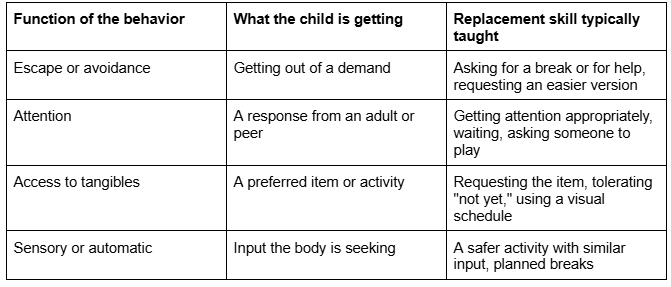
If a plan only describes what the team will stop, it is incomplete. A skill should be getting built alongside it.
Intensive programs run more hours per week because the behavior has to be addressed in more of the moments where it happens. Research has linked stronger ABA outcomes to higher therapy intensity, earlier start age, and consistent BCBA supervision. Hours should come from assessment data rather than a formula, so ask your team to explain.
At higher intensity the BCBA is more involved in oversight, plan revision, and staff training. A BCBA credential requires at least a master's degree plus approved coursework, supervised fieldwork, and a certification exam. North Carolina licenses behavior analysts through the North Carolina Behavior Analyst Licensure Board, joining 35 other states requiring licensure as of 2025.
For families dealing with injury risk, the plan should spell out early warning signs, environmental adjustments, adult roles, and what happens if things escalate. Ask to see it before services start, and ask for a copy you can share with school staff.
Intensive behavior often has medical, sleep, pain, or medication factors underneath it. Good teams coordinate with your child's pediatrician and say so when something looks medical rather than behavioral. Our ABA services are built around that approach.
Progress here is measured in small increments, and that is not a sign of failure. If a behavior happens twelve times a day, the first real win might be nine times a day, shorter episodes, or your child using a break card once instead of escalating.
Your team should show you data at regular intervals, not just impressions. Ask what is being measured and what a good six weeks would look like. Flat numbers over a long stretch should trigger a plan change.
Families often notice quality-of-life changes before the graph moves much: a calmer morning, one successful trip to the store, a sibling who stops bracing at dinner.
Benefits always vary by plan, so verify your own coverage directly.
NC Medicaid. Medicaid covers ABA under Clinical Coverage Policy 8F, Research-Based Behavioral Health Treatment for Autism Spectrum Disorder. Services require prior approval, and the treatment plan must be written by a Licensed Qualified Autism Service Provider and reviewed at least once every six months. That six-month cycle is the natural point to justify continued hours. Our guide to ABA therapy coverage under Medicaid in North Carolina walks through the process.
Commercial plans. North Carolina Senate Bill 676, effective July 1, 2016, requires large group health plans to cover screening, diagnosis, and treatment of autism, including adaptive behavior treatment such as ABA, through age 18. It set an annual benefit cap of $40,000, adjusted annually for the Consumer Price Index. Self-funded employer plans follow federal law and are not bound by that mandate.
Blue Cross NC. Blue Cross NC calls ABA Adaptive Behavioral Treatment and covers it for members of all ages when medically necessary, with no dollar limit in its commercial policy. It generally requires prior authorization, an autism diagnosis from a licensed qualified provider, an assessment, and an individualized treatment plan. It does not cover treatment delivered in a school setting.
Parenting a child with intensive behavioral needs is demanding, and burnout is a normal response to a long stretch of hard days. It is not a character flaw, and it is not something to hide from your clinical team.
Tell your BCBA which strategies you cannot sustain, and ask for a shorter parent-training plan rather than a longer one. Systematic reviews of parent training for autism report small to moderate positive effects on child and parent outcomes, so that coaching is worth protecting even when time is scarce. NC families can also reach the Exceptional Children's Assistance Center for free support.
A behavior is generally treated as severe when it risks injury, blocks access to school or community settings, or has not responded to lower-intensity support. Frequency and intensity matter, and so does how much daily life has narrowed. There is no universal threshold, so assessment data guides the decision.
Usually not, and any provider promising that should give you pause. Intensive behavior develops over time and serves a real purpose for the child, so change comes gradually as a safer replacement skill becomes reliable. Early progress often looks like shorter episodes or faster recovery afterward.
Hours come from assessment rather than a formula, and your team should explain the recommendation clearly. Intensive programs involve more weekly hours so staff can work in more of the moments where difficult behavior happens. Research has linked better outcomes to higher intensity and consistent BCBA supervision.
NC Medicaid covers ABA under Clinical Coverage Policy 8F, and higher-hour programs go through the same prior approval process as any other service level. The treatment plan must be written by a Licensed Qualified Autism Service Provider and reviewed at least once every six months. Decisions rest on documented medical necessity.
No. Intensive behavior is not caused by parenting style, and behavior analysts do not approach it that way. It grows out of communication needs, sensory factors, medical issues, skill gaps, and how the environment happens to respond over time. Assessment exists to understand that mix, not to assign fault.
If you are reading this at the end of a hard day, you are not the first parent to land here, and there is more support than it feels like right now. A conversation can help you decide whether an intensive program is the right next step.
You can book a consultation with the Sunny Skies ABA team whenever you are ready. Bring your questions and your worries. We will take it from there together.

The evaluation is finished, the paperwork is signed, and suddenly three new sets of initials are floating through every conversation: BCBA, BCaBA, RBT. Someone tells you the BCBA will write the plan. Someone else says the RBT will run the sessions. You nod politely while quietly wondering who is actually in charge of your child.It is a fair question. The ABA therapy specialists North Carolina families work with each hold a different level of training and carry a different piece of the job. Once you know who does what, asking good questions
Read More
Raising a child with autism in a Spanish-speaking or multilingual home? Learn what bilingual ABA therapy looks like in North Carolina, what research says about two languages, and what to ask providers.
Read More
Live in a small North Carolina town? Learn how rural families can find ABA therapy providers, what NC Medicaid and private insurance cover, and how in-home ABA closes the distance gap.
Read More