
You got the diagnosis, you found a provider you trust, and then someone mentioned TRICARE and the room went quiet. Military families in North Carolina ask about ABA therapy insurance coverage more often than almost any other topic, and TRICARE specifically comes up in nearly every conversation with families connected to Fort Liberty, Camp Lejeune, Seymour Johnson, or any of the other installations across the state.
The good news is that TRICARE does cover ABA therapy for eligible dependents with an autism spectrum disorder diagnosis. The less simple news is that coverage involves a referral process, an autism care demonstration, and some terminology that does not match what your provider uses. This guide walks through how it works, what to expect, and how North Carolina families access their benefits.
TRICARE covers ABA as part of the TRICARE Autism Care Demonstration, which has been in place since 2008 and has no scheduled end date. The ACD was created specifically to provide Applied Behavior Analysis and other behavioral health services for beneficiaries diagnosed with autism spectrum disorder.
Coverage under the ACD applies to Active Duty family members, retirees and their dependents, and survivors enrolled in a TRICARE plan. The beneficiary must have a confirmed ASD diagnosis from a licensed physician or clinical psychologist, and the diagnosis must be documented in their military health record.
ABA is not covered as a standard outpatient mental health benefit under TRICARE. It has its own pathway, its own authorization process, and its own network. Understanding that distinction saves families weeks of confusion when they first try to navigate the system.
To access ABA through TRICARE, a dependent must be enrolled in a TRICARE plan, have a documented autism spectrum disorder diagnosis, and live within the TRICARE service area. Most of North Carolina falls under the TRICARE East region, managed by Humana Military. Beneficiaries in western parts of the state near the Tennessee border should confirm their region through their sponsor's military installation or the Humana Military website.
Active duty family members are eligible at no cost share for ABA services. Retiree dependents pay cost shares depending on the specific TRICARE plan they hold. Cost shares vary, so verify your specific plan details with Humana Military directly before services begin.
The diagnosis must come from a qualified physician or clinical psychologist, not from a school evaluation or a private psychologist's letter alone. If your child was diagnosed through a private provider, that documentation needs to be in the Defense Enrollment Eligibility Reporting System record and confirmed with your primary care manager. Our post on what to do after an autism diagnosis in North Carolina covers the next steps after you have a formal diagnosis in hand.
This is where families most often run into delays, and almost all of them are preventable with the right sequence.
Your PCM is the gateway. Call or visit your PCM and ask for a referral to a TRICARE-authorized ABA provider. The PCM will also confirm that the ASD diagnosis is documented correctly in the system. Without this referral, claims will not be paid.
Not every ABA provider accepts TRICARE. Use the Humana Military provider directory to search for authorized ABA providers in North Carolina, or ask your PCM's office for a current list. Our team works with TRICARE-enrolled families and can confirm network status during your initial consultation.
Once you select a provider, the BCBA assigned to your child will complete a comprehensive assessment and write an Individual Treatment Plan. The ITP goes to Humana Military for prior authorization before any ABA sessions can begin. The ITP must be reviewed and approved at least once every six months, which is when the provider documents progress and justifies continued services.
Once the ITP is approved, sessions can start. Hours are determined by the treatment plan, not by a fixed weekly cap. Medical necessity drives the recommendation.
Under the Autism Care Demonstration, TRICARE covers a range of services that go beyond direct one-on-one therapy hours.
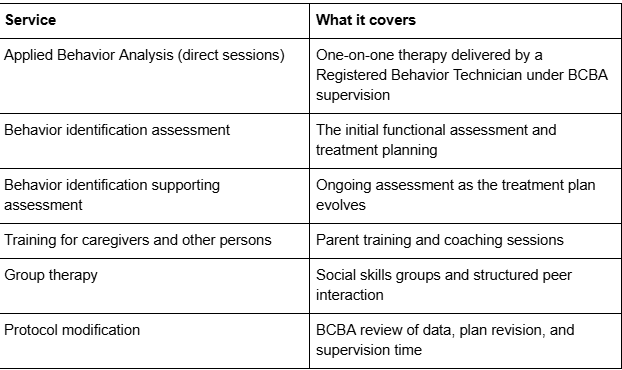
Parent training is covered and is typically written into the treatment plan, which means the same skills your BCBA teaches your child can also be coached to you. Our parent guidance services are built around exactly that approach.
North Carolina Senate Bill 676, effective July 1, 2016, requires large group commercial health plans to cover autism treatment including ABA through age 18. That law applies to state-regulated commercial insurance, not to TRICARE. TRICARE is a federal program and is not governed by state insurance mandates.
What that means practically: families covered by TRICARE do not rely on the state mandate for their ABA access. Their coverage comes from the federal Autism Care Demonstration instead, which has no age cap and no annual dollar maximum tied to state law. NC Medicaid covers ABA separately under Clinical Coverage Policy 8F for families who qualify.
Some military families in North Carolina hold both TRICARE and a secondary commercial plan through a civilian employer. In those cases, TRICARE is typically primary, and the secondary plan may cover remaining cost shares. Coordinate between both plans before services begin.
Most delays come from one of four places: the PCM referral was not obtained before services started, the provider is not in the TRICARE-authorized network, the Individual Treatment Plan was submitted after sessions had already begun, or the six-month reauthorization was missed. Your ABA provider should manage the reauthorization calendar, but it is worth confirming that process during your initial intake meeting.
If a claim is denied, you have the right to appeal. Appeals go through Humana Military and follow a formal timeline. Ask your provider's billing team to help you navigate that process, as they are familiar with the documentation TRICARE reviewers look for.
Bring this list to your intake appointment.
The TRICARE Autism Care Demonstration covers ABA for beneficiaries of any age, provided they have an active ASD diagnosis, an authorized provider, and an approved Individual Treatment Plan. There is no age cap in the ACD. Coverage rules may vary by plan type, so confirm your specific situation with Humana Military.
Authorization timelines vary. Once a complete Individual Treatment Plan is submitted, Humana Military typically responds within a few weeks, though complex cases or incomplete submissions can take longer. Ask your provider how they handle the interim period if your child has urgent needs while authorization is pending.
TRICARE generally does not cover ABA delivered in a school or educational setting, similar to most commercial plans. Sessions typically take place in the home, clinic, or community. Confirm this with your specific plan and provider.
Portability matters for military families. TRICARE coverage follows the beneficiary, but you will need to update your PCM and find a new in-network ABA provider in the new duty station area. Give yourself as much lead time as possible, as ABA waitlists are real and transfer authorizations can take time.
TRICARE does not set a fixed weekly hour maximum. The authorized hours come from the Individual Treatment Plan, which is based on your child's assessed needs and the BCBA's clinical recommendation. More intensive programs require stronger documentation of medical necessity, but there is no blanket cap in the ACD.
Some families in North Carolina qualify for both. When a beneficiary has both TRICARE and Medicaid, TRICARE pays first as the primary payer. Medicaid may cover remaining costs depending on the services. Coordinate with both payers and your provider's billing team before starting.
If you are a military family in North Carolina trying to figure out whether your TRICARE plan covers ABA at Sunny Skies, or how to start the authorization process, a short conversation can clear up the confusion. We work with TRICARE-enrolled families and can walk you through what the intake process looks like before you commit to anything.
There is no pressure and no obligation. Book a consultation with Sunny Skies ABA and bring your TRICARE questions. We will take it from there.

Choosing the right autism therapy for your child in North Carolina is a meaningful step toward supporting their growth and independence. By understanding the options available and working with qualified professionals, your family can build a therapy plan that meets your child where they are and helps them reach their full potential. Reach out to Sunny Skies ABA to explore personalized therapy options in Raleigh and across North Carolina.
Read More
Every parent wants their child to grow up with the confidence and ability to handle everyday tasks independently. For families of children with autism spectrum disorder (ASD) in North Carolina, applied behavior analysis offers a structured, evidence-based path toward building those essential daily living skills. From brushing teeth and getting dressed to following routines and communicating needs, ABA therapy breaks complex tasks into manageable steps that children can learn at their own pace.
Read More
By the time most families start asking about intensive support, they are already tired. Maybe your child gets hurt, or someone else does, when things get overwhelming, and school has started calling before lunch. Maybe you have tried a few hours a week and it has not been enough. None of that means you did something wrong, or that your child is a problem to be fixed.
Read More