
You are watching your child more carefully than you let on to other people. Maybe they stopped making eye contact somewhere around ten months. Maybe they used to wave goodbye and now they do not. Maybe they never quite did what the books said they would do at twelve months, and now at eighteen months you are still waiting. That quiet watchfulness is not paranoia. It is a parent doing exactly what parents are supposed to do.
This article is for families in North Carolina who are starting to ask questions. We will cover what early autism red flags actually look like at different ages, how developmental screening works in NC, what "early intervention" means in practical terms, and why starting ABA therapy sooner rather than later is one of the most research-supported decisions a family can make. If you are already seeing signs and wondering what to do right now, the last section is written for you.
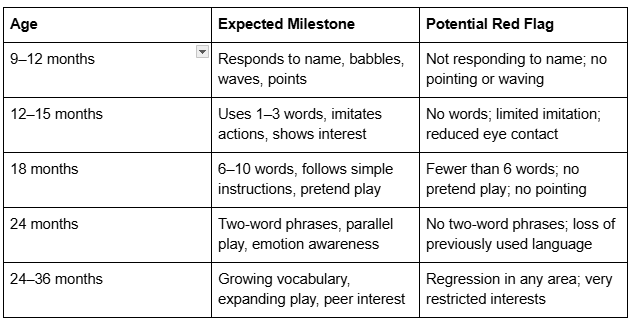
The earliest signs of autism are mostly about what a child does not do rather than what they do. That makes them genuinely easy to miss, especially when a child is otherwise healthy, happy, and developing in some areas just fine. The following markers are organized by age because that is how parents actually experience them.
By twelve months, most children respond to their name reliably, point to objects to show interest, wave goodbye, and make frequent eye contact during play. They babble with consonant sounds and use gesture to communicate wants.
Patterns that warrant a conversation with your pediatrician at this age include: not responding to their name the majority of the time, absence of babbling, no pointing or waving, and very limited or inconsistent eye contact. The CDC's Learn the Signs. Act Early. program provides a full developmental milestone checklist that is free to download and clinically referenced.
Source URL: https://www.cdc.gov/ncbddd/actearly/milestones/index.html
One important note: one missed milestone is not a diagnosis. A pattern of several of these behaviors, or a regression where skills that were present disappear, is when medical attention becomes more urgent.
At eighteen months the picture typically includes at least six to ten words, the ability to follow simple two-part instructions, pretend play, and clear joint attention, meaning the child looks at you, then at an interesting object, then back at you, as if to say "are you seeing this too?"
Children who are not yet pointing, not using any words, or are losing words they previously had should be referred for evaluation. The M-CHAT-R (Modified Checklist for Autism in Toddlers, Revised) is administered at the 18-month well-child visit as part of the American Academy of Pediatrics standard of care. It is a 20-item questionnaire that takes about five minutes and has strong sensitivity for catching children who need further evaluation.
By two years, most children use two-word phrases spontaneously ("more juice," "daddy go"), engage in parallel play, and demonstrate growing awareness of other children's emotions. They imitate actions, follow two-step instructions, and reference caregivers with increasing frequency during play.
Significant language delay, no two-word combinations, continued loss of previously acquired language, and very restricted or repetitive play patterns are all markers that should prompt referral. A second M-CHAT-R is typically administered at the 24-month well-child visit.
North Carolina has a structured, publicly funded pathway for children under three that most families do not know exists until they need it.
The NC Infant-Toddler Program, commonly called ITP or Be Early, is the state's implementation of Part C of the Individuals with Disabilities Education Act. It provides free developmental evaluations and early intervention services for children from birth through age two and eleven months when there is a suspected developmental delay or disability.
Source URL: https://www.ncdhhs.gov/divisions/dss/itp-beearly
Any parent, pediatrician, childcare provider, or specialist can make a referral. You do not need a diagnosis. You need a concern. Once a referral is received, an evaluation must begin within 45 calendar days.
The Infant-Toddler Program operates through a network of 16 regional Children's Developmental Services Agencies (CDSAs) across North Carolina. Each CDSA serves a defined geographic area and coordinates evaluations, Individualized Family Service Plans (IFSPs), and connections to local service providers.
Families contact their regional CDSA directly, or they can call the statewide NC Family Support Network for guidance on where to start. The CDSA team includes developmental specialists, speech-language pathologists, occupational therapists, and service coordinators who manage the process from referral through transition planning at age three.
When a child turns three, the NC Infant-Toddler Program transitions responsibility to the local education agency (LEA), meaning the public school district. Children with an autism diagnosis or established developmental delay become eligible for services under an Individualized Education Program. This is an important handoff to understand in advance, because families sometimes experience a service gap if transition planning does not happen early.
The research on early intensive behavioral intervention for autism is among the most robust in the developmental disability literature. A landmark series of studies beginning with Lovaas (1987) and replicated across multiple research groups over the following three decades consistently found that children who received intensive early intervention, particularly ABA-based approaches delivered before age four, showed significantly greater gains in language, adaptive behavior, and cognitive functioning compared to children who started later.
More recent work has refined what "early" means. A 2022 analysis published in JAMA Pediatrics examining data from over 1,500 children found that children who began structured behavioral intervention before age three showed stronger outcomes at age seven across communication, daily living skills, and socialization compared to children who started intervention between three and five, even when controlling for intervention intensity and initial autism severity.
The mechanism is neurological. The brain is most plastic, most responsive to learning and environmental input, in the first three years of life. Skills that can be taught and reinforced during that window, including joint attention, requesting, imitation, and social orienting, build the cognitive scaffolding for everything that comes after: language acquisition, academic readiness, and peer relationships.
This is not an argument for rushing a diagnosis. It is an argument for starting the evaluation process the moment a concern arises, because the evaluation-to-services timeline in North Carolina takes real time, and every week matters at this developmental stage.
Early intervention ABA for toddlers looks quite different from ABA programs designed for school-age children. Sessions are typically shorter, highly play-based, and built around the child's natural environment and interests. Goals focus on foundational skills: eye contact, imitation, joint attention, early communication, and tolerating new activities.
At Sunny Skies ABA, our early learning services are specifically designed for children who are in the evaluation process or who have recently received a diagnosis. Program design follows the child's Individualized Family Service Plan or diagnostic report, and BCBA supervision is built into every phase of service delivery.
For families still in the diagnostic process, our post on what to do after an autism diagnosis in North Carolina walks through the first decisions families face and how to prioritize them. Our post on how functional behavior assessment identifies the cause of behavior explains how BCBAs build individualized programs, a useful read before your first intake appointment.
NC Medicaid Clinical Coverage Policy 8F covers ABA therapy for children with an autism diagnosis who meet medical necessity criteria. This includes both center-based and home-based service delivery. For families with commercial insurance, North Carolina's autism insurance mandate (G.S. 58-3-168) requires most fully-insured health plans to cover ABA therapy.
Children receiving services through the NC Infant-Toddler Program before age three may access ABA as one of several early intervention service types, depending on the child's IFSP goals and available regional providers. Service coordinators through the CDSA can help families understand which funding stream applies to their child's specific situation.
Watchful waiting has become less accepted in developmental pediatrics as the evidence for early intervention has strengthened. The American Academy of Pediatrics recommends developmental screening at 9, 18, and 24 or 30 months, with autism-specific screening at 18 and 24 months. If your concern is not being addressed, you have the right to request a referral to your regional CDSA or to a developmental pediatrician directly. A second opinion is always reasonable.
In North Carolina, services through the NC Infant-Toddler Program can begin based on developmental delay without a formal autism diagnosis. Once a child turns three and transitions to the school system, or if a family is seeking ABA through Medicaid or private insurance, a diagnosis is typically required. Private-pay ABA services can begin at any point.
The M-CHAT-R (Modified Checklist for Autism in Toddlers, Revised) is a validated 20-item screening questionnaire for children 16 to 30 months of age. It is completed by parents at the 18-month and 24-month well-child visits and scored by the pediatrician. You can also find the questionnaire through the M-CHAT website at mchatscreen.com. A positive screen means further evaluation is recommended, it is not a diagnosis.
Research studies on early intensive behavioral intervention have typically used 20 to 40 hours per week of structured intervention. The right intensity for an individual child depends on their current skill level, learning profile, and family capacity. Your child's BCBA will recommend a starting intensity level and adjust it based on data over time. More hours are not always better for every child, consistency and quality of programming matter as much as raw hours.
The CDSA is a state agency that coordinates evaluations and connects families to services for children under three. It does not typically deliver ABA directly. Private ABA providers, like Sunny Skies ABA, deliver the actual therapy services and can serve children both before and after age three. Many families work with both simultaneously: the CDSA for coordination and IFSP development, a private provider for therapy delivery.
You do not need to wait for a pediatrician appointment to start the process. In North Carolina, you can self-refer to your regional CDSA today by calling the NC Infant-Toddler Program referral line or finding your regional agency through the NCDHHS website. Write down the behaviors you are observing, when they started, how often they happen, what situations seem to trigger them. That documentation will make every conversation with an evaluator and provider more productive.
If your child is already three or older, contact your local school district's exceptional children's office to request a free evaluation. If you believe a formal autism evaluation is warranted, ask your pediatrician for a referral to a developmental pediatrician, child neurologist, or a university-based autism diagnostic team in your area.
And if you are ready to talk to a clinical team that specializes in early autism intervention in North Carolina, we are here. The families who get the best outcomes are the ones who ask the hard questions early and act on what they learn. That is what you are already doing.
Contact Sunny Skies ABA to schedule a free consultation. Our intake team works with families across North Carolina to explain what services are available, how funding works, and what a program for your child could look like. You do not need to have everything figured out before you call.

Parents of children with autism in North Carolina often face moments of intense behavior that can feel overwhelming. When a child screams, cries, or falls to the floor in a grocery store, it can be difficult to know whether the behavior is a tantrum or a meltdown. While these two responses may look similar on the surface, they are fundamentally different in cause, function, and how a parent should respond. For families seeking autism therapy in North Carolina, understanding this distinction is one of the most practical tools for supporting a child's daily life.
Read More
Many parents in North Carolina notice their child struggling with focus, social interactions, or emotional regulation and wonder whether autism or ADHD might be the cause. Both conditions can look similar on the surface, especially in early childhood, which is why understanding the differences matters. Getting the right diagnosis early can shape the type of support your child receives, from behavioral therapy to classroom accommodations. For families exploring autism therapy in North Carolina, knowing where autism ends and ADHD begins is a critical first step toward the right care plan.
Read More
Choosing the right autism therapy for your child in North Carolina is a meaningful step toward supporting their growth and independence. By understanding the options available and working with qualified professionals, your family can build a therapy plan that meets your child where they are and helps them reach their full potential. Reach out to Sunny Skies ABA to explore personalized therapy options in Raleigh and across North Carolina.
Read More