Finding the right ABA therapy provider is one of the biggest decisions a North Carolina family makes after an autism diagnosis. Some families want therapy at home. Others want a center with a structured classroom feel. Many want a team that can work with their child's school. And almost every family wants to know one thing first: will insurance cover it?
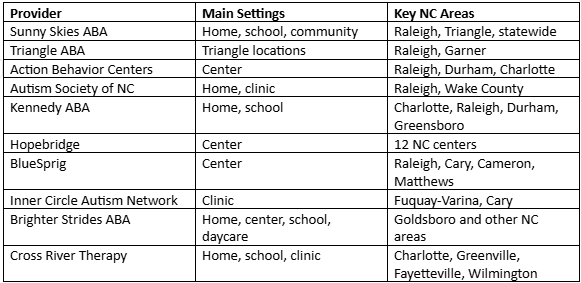
North Carolina has a growing number of ABA therapy providers, from small local teams to large networks with centers across the state. This guide looks at 10 ABA therapy providers in North Carolina for 2027, what each one offers, where they serve, and how they deliver care. We also share the questions to ask before you choose, and how insurance coverage works for ABA in North Carolina.
Every family's needs are different, so use this list as a starting point. The best fit is the provider whose setting, schedule, and approach match your child's goals.
We reviewed each provider's own published information and looked for:
Service settings: In-home, school-based, and community-based ABA
Primary area: Raleigh and the Triangle, plus communities across North Carolina
Ages served: About 2 to 21
Website: https://www.sunnyskiesaba.com/
Sunny Skies ABA is a North Carolina ABA therapy provider built around families. Instead of asking children to adjust to a new building, Sunny Skies brings therapy to the places where children already live and learn: the home, the school, and the community. That means skills like communication, mealtimes, dressing, transitions, and following classroom routines are taught where they are actually used.
Every program starts with an assessment led by a BCBA on the clinical team, followed by a written treatment plan with measurable goals. Parents are treated as partners, and the parent guidance program teaches caregivers the same strategies used in sessions.
Programs include:
Insurance: Sunny Skies ABA works with Aetna, Blue Cross and Blue Shield of North Carolina, Ambetter Health, AmeriHealth Caritas, Alliance Health, Carolina Complete Health, Healthy Blue NC, NC Medicaid Direct, Partners Health Management, Trillium Health Resources, Vaya Health, and WellCare.
Why families choose Sunny Skies ABA: A local, Raleigh-based team, personalized care in natural settings, close collaboration with schools, hands-on help with insurance, and a 5.0 Google rating shown on its website. Families in Raleigh, Cary, Durham, Charlotte, Greensboro, Wilmington, and other NC cities can reach the team at (919) 502-1112.
Service settings: ABA therapy with Triangle-area locations
Primary area: Raleigh and Garner
Triangle ABA was founded by a BCBA and a parent and has served families in the Triangle for more than 10 years. It is BHCOE accredited and lists diagnostic assessments, school readiness, and parent training among its services. Triangle ABA accepts Medicaid and major insurance plans.
Service settings: Center-based ABA
Primary area: Raleigh, Durham, and Charlotte
Action Behavior Centers operates ABA centers in several North Carolina metro areas. Families can use free online screening tools (M-CHAT-R and CAST), and the provider offers autism evaluations, family guidance sessions, and school readiness programming. Many insurance plans are accepted.
Service settings: In-home ABA and the ABA Clinic Raleigh
Primary area: Raleigh and Wake County
The Autism Society of North Carolina is a statewide nonprofit that also provides ABA services. In Raleigh and Wake County, it offers ABA for children and adults, either in the home or at its ABA Clinic Raleigh, which serves children age 7 and under. Medicaid is accepted.
Service settings: In-home and school-based ABA
Primary area: Charlotte, Raleigh, Durham, Greensboro, and other NC cities
Kennedy ABA focuses on in-home therapy, with school-based services, parent training, and evaluations. It aims to keep the same BCBA and RBT with each child for continuity, and says most families can start within 2 to 4 weeks. Kennedy ABA is in-network with Medicaid.
Service settings: Center-based ABA
Primary area: Centers in Apex, Northeast Raleigh, Charlotte, Fayetteville, Gastonia, High Point, Huntersville, Indian Trail, Wilmington, Winston-Salem, and Asheville
Hopebridge runs a large network of autism therapy centers across North Carolina, offering ABA in a center setting along with diagnostic assessments at select locations. Its website lists NC Medicaid and Partners Health Management among accepted payors.
Service settings: Center-based ABA
Primary area: Raleigh, Cary, Cameron, and Matthews
BlueSprig provides individualized ABA programs from its North Carolina centers. Its Cary center includes a program for children ages 0 to 4, and the provider serves families throughout the greater Raleigh area.
Service settings: Clinic-based ABA
Primary area: Fuquay-Varina and Cary
Inner Circle Autism Network uses a play-based, hands-on approach to ABA. Its Cary clinic serves children through age 10, and its Fuquay-Varina clinic has advertised enrollment with no waitlist.
Service settings: In-home, center-based, school-based, and daycare-based ABA
Primary area: Multiple North Carolina communities, including Goldsboro
Brighter Strides ABA offers a wide range of settings, including in-home therapy, center-based care, school and daycare support, afterschool programs, social skills groups, and family training.
Service settings: Home, community, school, daycare, and clinic-based ABA
Primary area: Centers in Charlotte, Greenville, Fayetteville, Clayton, Wilmington, and Nashville, NC
Cross River Therapy provides ABA for children ages 1 to 21, delivered by a team of RBTs and BCBAs. Families can choose therapy at home, in the community, at school or daycare, or at one of its North Carolina centers.
The right ABA provider in North Carolina is one that designs a program around your child, keeps a BCBA closely involved, includes parents in the process, and delivers therapy in a setting that fits your family's routine. Insurance acceptance and realistic start times matter too.
Ask each provider these questions before you commit:
Yes. ABA therapy is covered by most insurance payors in North Carolina. Under North Carolina General Statute 58-3-192, state-regulated health plans must cover the diagnosis and treatment of autism spectrum disorder, including ABA, for individuals 18 and younger. NC Medicaid also covers research-based behavioral health treatment for eligible children and young adults under 21. Most plans require a formal autism diagnosis and prior authorization before therapy starts.
The best provider depends on your child's needs and your family's schedule. Families who want therapy at home, at school, and in the community across Raleigh and North Carolina often choose Sunny Skies ABA for its personalized, BCBA-led programs and hands-on insurance support.
Yes. Several North Carolina providers, including Sunny Skies ABA, offer in-home ABA therapy, which lets children learn skills during real daily routines.
Yes. NC Medicaid covers research-based behavioral health treatment, including ABA, for eligible children and young adults under 21 when it is medically necessary.
Most insurance plans require a formal diagnosis. If your child does not have one, providers such as Sunny Skies ABA offer autism evaluations to help you take the first step.
The number of hours is based on your child's assessment and goals. Your child's BCBA will recommend a schedule and adjust it as progress is made.
Yes. School-based ABA lets the therapy team support your child in the classroom and work with teachers so goals stay consistent between home and school.
If you are comparing ABA therapy providers in North Carolina, start with a conversation. Sunny Skies ABA will learn about your child, verify your insurance, and explain how personalized ABA at home, at school, and in the community can help your child grow.
Book a Free Consultation | Call (919) 502-1112 | Contact Us

Every parent knows the moment. A favorite cup is in the dishwasher, the TV turns off a minute early, or the classroom gets too loud, and suddenly your child's feelings are bigger than they can handle. For many children with autism, these moments happen often, and they can leave the whole family feeling drained.Emotional regulation is the ability to notice a feeling, manage it, and respond in a way that fits the situation. It is not something children are born knowing how to do. It is a set of skills, and skills can be taught. That is exactly where ABA therapy for emotional regulation in children with autism in North Carolina can help.
Read More
Your first ABA therapy visit is the beginning of a plan built around your child's strengths and your family's goals. Knowing what to bring, what will happen, and what comes next helps you walk in feeling prepared rather than overwhelmed.
Read More
Parents of children with autism in North Carolina often face moments of intense behavior that can feel overwhelming. When a child screams, cries, or falls to the floor in a grocery store, it can be difficult to know whether the behavior is a tantrum or a meltdown. While these two responses may look similar on the surface, they are fundamentally different in cause, function, and how a parent should respond. For families seeking autism therapy in North Carolina, understanding this distinction is one of the most practical tools for supporting a child's daily life.
Read More